

10 Backyard Play Ideas for Kids This Spring: Easy Outdoor Games for Toddlers & Preschoolers
🌿 Why the Backyard Can Be a Child’s Best Outdoor Classroom
For young children, the backyard can be one of the easiest places to begin spring outdoor activities. It feels more familiar than a park, more open than indoor play, and much less pressured than a scheduled class or big outing. That sense of comfort matters, especially for little ones who learn best when they can move, pause, repeat, and explore at their own pace.
That is why some of the best backyard play ideas are not complicated at all. In a simple outdoor space, children can run, jump, notice textures, invent stories, and practice the same skill again and again without even realizing it. A backyard does not need to be fancy to become a meaningful space for outdoor play for toddlers and preschoolers. What matters most is that it invites children to come back, try again, and enjoy being outside ☀️

🌼 10 Simple Backyard Play Ideas for Spring
Here are ten easy backyard play ideas that blend movement, sensory fun, imagination, and social play. The best outdoor games to play are often the ones that are easy to start, fun to repeat, and flexible enough to grow with your child.
1. Bubble Chase 🫧
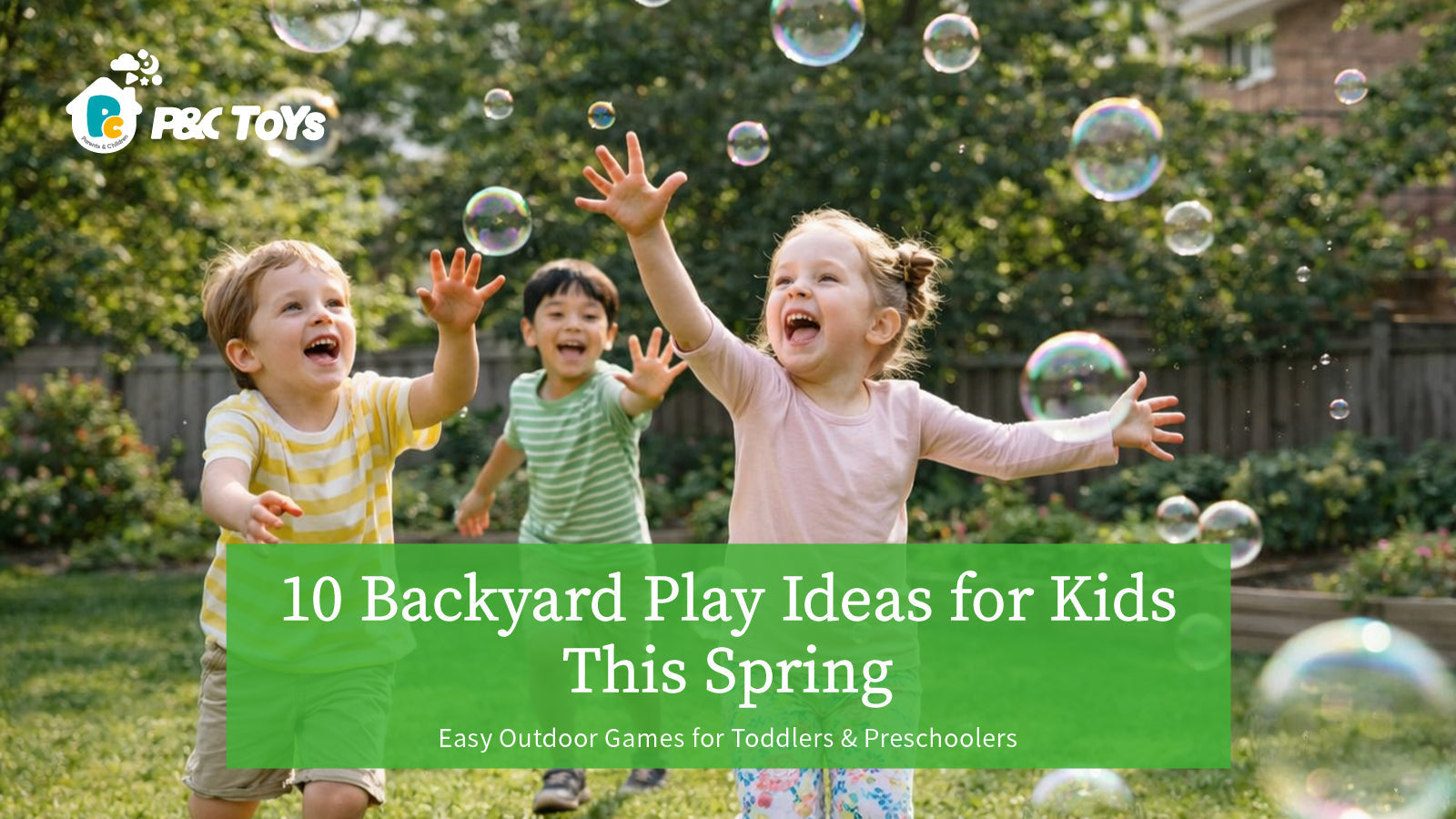
Few things feel more like spring than bubbles drifting across the yard. Use a bubble machine, a bubble wand, or other bubble toys to send bubbles floating at different heights and speeds, then let children run, reach, pop, or try to catch them. It is a simple way to turn the backyard into an active play space while keeping the mood light, playful, and full of spring joy ✨
Why kids love it:
-
movement and excitement
-
visual tracking
-
early coordination
2. Jump the Path 🖍
Use chalk, rope, or small objects to create a path on the ground. Children can step over, jump across, tiptoe around, or follow the path in different ways, depending on their age. This makes it one of the easiest gross motor activities outdoors because it can be changed again and again without much setup.
What it builds:
-
balance
-
coordination
-
body control
3. Color Hunt in the Yard 🎨
Invite children to look for something green, yellow, pink, or blue in the backyard. They might notice flowers, leaves, toys, or even tiny details they usually pass by. This is one of those gentle nature play activities that encourages kids to slow down, observe, and connect with the season.
What it supports:
-
color recognition
-
observation
-
curiosity
4. Water-and-Texture Station 💧
Set out a bowl of water with leaves, grass, stones, petals, cups, or scoops, and let children explore freely. Some may pour and splash, while others may sort, touch, and compare textures. It is an easy way to create backyard sensory activities without needing a big setup or special tools.
Why it works so well:
-
tactile exploration
-
sensory play
-
calm, open-ended fun
5. Push-and-Pull Mission 🖐
Give children a small task, like pushing a toy truck, pulling a basket, or moving a few lightweight items from one place to another. Adding a purpose makes the game feel more engaging, especially for younger children who enjoy “helping.” This is a great example of outdoor play for toddlers that feels active and meaningful at the same time.
What it encourages:
-
body awareness
-
coordination
-
confidence through purposeful play
6. Follow the Moving Toy 🚗
Use a moving toy, like an RC vehicle for toddlers or a drift RC for older kids, and let children follow it as it turns, pauses, or changes direction around the yard. You can make it more fun by adding simple challenges, like “stop when it stops” or “turn when it turns.” These kinds of backyard play toys help children stay focused while keeping the game playful.
What kids practice:
-
focus
-
direction changes
-
start-and-stop control
7. Backyard Pretend Play 🦖
Bring a few dinosaur toys, animal figures, or spring-themed props outside and create a simple pretend-play setup in the grass. A backyard can quickly become a jungle, a construction site, or a tiny adventure world. This kind of imaginative outdoor play is especially helpful for language, storytelling, and role play.
Why it matters:
-
imagination
-
language development
-
social interaction
8. Task Card Play 💡
Set up simple “missions” using construction truck toys or vehicle sets, such as load, drive, and unload. Older children can follow basic task cards, while younger ones can copy the sequence with help. It works especially well as one of the more structured outdoor games that preschool children can enjoy together.
What it develops:
-
hand-eye coordination
-
cause and effect
-
turn-taking and teamwork
9. Nature Collect-and-Tell 🌸
Ask children to collect a few safe natural objects, then tell you what they found and why they chose them. A leaf, flower petal, smooth stone, or tiny stick can easily become part of a little story. This is one of the simplest forms of nature play children can enjoy in the backyard, and it works beautifully in spring.
What it builds:
-
observation
-
vocabulary
-
storytelling confidence
10. Mini Backyard Challenge Course 🎯
Combine a few of the activities above into one simple backyard flow. For example, children can chase bubbles, jump a line, carry a basket, and then find something green before finishing the course. This is one of the most flexible backyard play ideas because it brings together movement, problem-solving, and fun in one playful routine.
Why families love it:
-
combines multiple skills
-
easy to adjust by age
-
fun to repeat in new ways
🧺 How to Make a Backyard Play Space Feel Fun Without Spending Much
These backyard play ideas do not need a big setup to work well. Many of the spring outdoor activities for kids begin with a few simple items and a little intention.
Try these easy ideas:
-
Create simple play zones. A movement corner, a sensory corner, and a pretend play corner can already make the space feel more inviting.
-
Rotate instead of overload. Putting out fewer items often helps children focus better and play more creatively.
-
Use what you already have. Baskets, ropes, balls, toy cars, chalk, and natural materials can all become part of everyday outdoor fun.
A playful setup matters more than a perfect one. Even a small space can support backyard activities for toddlers and bigger kids when it feels easy to use and easy to return to.

🚲 How Backyard Play Can Grow with Your Child by Age
One of the best things about backyard play is how easily it grows with children. The same outdoor space can support very different kinds of fun depending on age, confidence, and interest.
For toddlers (18 months - 3 years), the best activities are usually simple, sensory, and easy to repeat. Outdoor play for toddlers often works well when children can move freely, explore textures, and enjoy playful cause-and-effect moments without too many rules.
For preschoolers (3 years - 5 years), children often enjoy structure, repetition, and imagination. Outdoor play for preschoolers can feel especially rewarding at this stage, because simple games like color hunts, path challenges, and pretend play begin to hold their attention for longer.
For school-aged children (6 years - 12 years), backyard play often becomes more independent and more social. At this stage, spring outdoor activities can include bigger challenges, cooperative games, and more creative missions that give children room to move, problem-solve, and make the play their own.
🌈 A Backyard That Grows with Your Child
The best backyard games do not need to be complicated, and they do not need to happen all at once. What matters most is creating a space where children can move, imagine, explore, and come back for more.
This spring, even a small outdoor space can become a place full of learning, laughter, and family joy. With a few simple backyard toys for kids, a little fresh air, and room to play, the backyard can become one of the most meaningful classrooms a child has.
Create Infinite Fun Together.
Q&A
Q1. Why is backyard play good for kids?
A: Backyard play gives children a familiar, low-pressure outdoor space where they can move, explore, and repeat activities at their own pace. That kind of daily play supports gross motor development, imaginative play, and the confidence that grows when kids feel comfortable in their surroundings.
Q2. What are some fun backyard play ideas for kids?
A: Some of the easiest ideas are bubble chase, jump-the-path games, color hunts, water-and-texture play, and simple pretend-play setups. The best backyard play ideas are usually the ones that are easy to start, fun to repeat, and flexible enough to grow with your child.
Q3. What are some backyard sensory activities?
A: Backyard sensory activities can be as simple as a bowl of water, leaves, grass, stones, petals, cups, or scoops. These kinds of open-ended experiences help children explore texture, temperature, and movement while making outdoor play feel calm, playful, and hands-on.
Q4. How do you create a backyard play area on a budget?
A: A backyard play area does not need expensive equipment to feel fun. A few simple zones for movement, sensory play, and pretend play—using things like baskets, chalk, toy cars, ropes, or natural materials — can already turn the space into an inviting outdoor play area.
Q5. How do you adapt backyard play for different ages?
A: The same backyard activity can be adjusted by changing the distance, the number of steps, or the amount of guidance a child needs. Younger children usually do best with short, repeatable games, while older children often enjoy more challenge, simple rules, and cooperative play.