

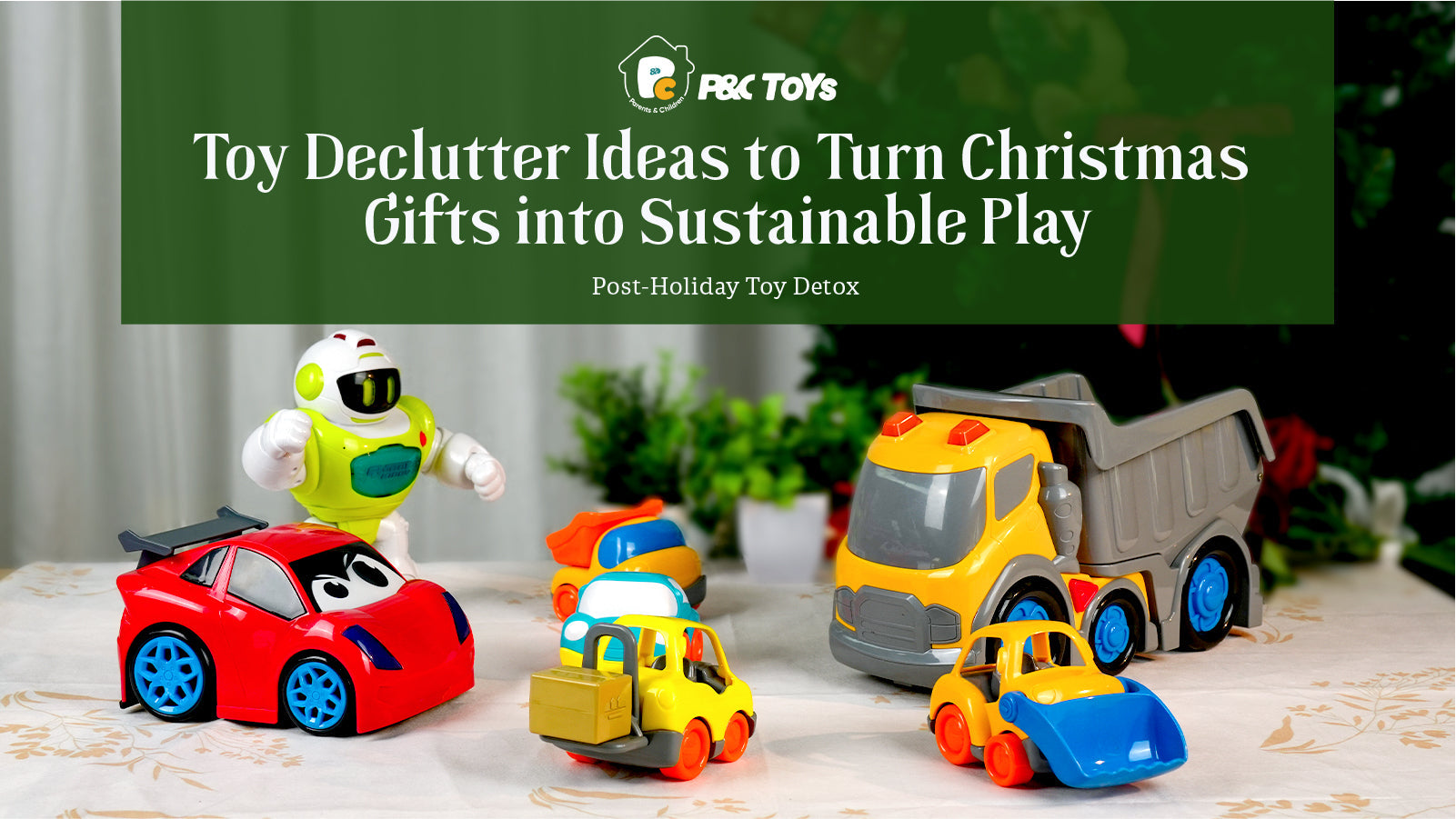
Post-Holiday Toy Detox: Toy Declutter Ideas to Turn Christmas Gifts into Sustainable Play
🧸 After the Holidays: When Toys Are Everywhere, but Play Feels Short
🧾 From One-Time Excitement to Long-Term Play

🧹 How to Declutter Toys After Christmas: Simple Decisions That Actually Work
-
Was it played with this month? If your child has played with the toy recently, that’s a clear sign of interest — it can be saved. If it hasn’t been touched for over a month, it may no longer match your child’s age or interests, which is your cue to move to the next question.
-
Is it broken or missing important pieces? Toys that are damaged or incomplete often create more frustration than play. If it can’t realistically be used again, it’s usually time to let it go.
-
Is it still age-appropriate for another child? Some toys aren’t “unused” — they’re simply outgrown. If there’s a younger sibling or a family member who could enjoy it, this is a good reason to save it for reuse.
-
Is it truly special? If a toy has emotional meaning — a gift from someone important or tied to a special memory — it deserves extra consideration. Even if it’s broken, respecting your child’s feelings matters. If it’s just an everyday toy, donation is often the best next step.
-
let go
-
donate
-
and save

✨ From Saved Toys to a Toy Rotation System That Keeps Play Fresh
Once you’ve decided which toys to SAVE, the next step isn’t putting everything back on the shelf. That’s how post-holiday toy clutter quietly returns.This is where a toy rotation system becomes essential. By limiting how many toys are available at one time and storing the rest in simple toy rotation storage, children feel less overwhelmed, stay focused longer, and engage more deeply with play. When toys rotate back in, they feel fresh again — without being new.However, rotation alone isn’t enough. What truly keeps toys engaging over time is how they’re used within the rotation.
💡 Change the Play, Not the Toy
-
A 12.2" Freewheel Dump Truck Set isn’t just driving — it delivers supplies, responds to emergencies, or completes tasks.
-
A R/C Dinosaur - Chompy The Dino becomes a story character instead of a figure to move around.
💡 Combine Toys Instead of Isolating Them
-
Cartoon vehicle toys + building blocks + small figures → create a city or construction site where vehicles transport materials, characters work together, and tasks are completed step by step
-
RC city service vehicles + blocks or figures → build pretend rescue scenarios with ambulances, fire trucks, and police cars responding across a child-made city.
-
Friendship bracelet kits + dolls or teddy bears → design accessories and outfits, adding a creative and personal storytelling layer.
-
Bubble machines + bath time or pet play → turn routines into sensory play moments and shared experiences.
These combinations directly answer a common parent question: how to get kids to play with old toys again — by giving familiar toys new roles within a shared context.
💡 Let Kids Co-Create the Play
-
Friendly Competition Invite friends over for small challenges, such as racing remote control cars or timing bracelet-weaving. These playful contests build focus, problem-solving, and social skills often associated with STEM toys.
-
Performance Play ✨ Use a magic kit to see who can learn and perform a trick smoothly. This type of play encourages observation, practice, and confidence — key elements of educational play.
-
Storytelling & Role Play Create open-ended storytelling sessions where children assign roles to parents and friends, act out scenes, and guide the narrative. This strengthens imagination, communication, and creative thinking.
-
Creative Building Encourage free building with blocks, focusing on exploration rather than instructions. Children test ideas, experiment with balance and structure, and naturally engage in STEM-style learning through hands-on play.

🌱 Sustainable Play Is a Skill That Grows
Q&A
Q1. How to teach a child to value their toys?
A1: Children learn to value their toys through daily habits, not lectures. Involving them in cleaning up toys, organizing play spaces, and deciding which toys to save during a post-holiday toy detox helps build responsibility and gratitude naturally. When toys are reused and rotated instead of easily replaced, children learn that toys are meant to last, not be disposable.
Q2. How to make old toys fun again?
A1: To make old toys fun again, focus on changing the play rather than the toy. Combine different toys for shared play, add new roles or challenges, and invite children to help design the game. These approaches encourage deeper engagement and are one of the most effective ways to get kids to play with old toys again.
Q3. What to do with broken toys?
A: Start by seeing if broken toys can be upcycled, such as using parts for craft projects or pretend play. If a toy can’t be safely repaired, reused, or donated, it’s okay to let it go. Involving children in this decision helps them understand toy care and sustainable play habits.
Q4. Does having fewer toys help a child's development?
A: Yes, having fewer toys available at one time can support a child’s development. Research and Montessori-inspired approaches suggest that reduced clutter helps children concentrate longer, play more creatively, and develop problem-solving skills. Toy rotation allows families to balance variety with focus.
Q5. What are some indoor active play ideas for winter?
A: Indoor active play ideas include building obstacle courses with blocks, creating toy car tracks from cardboard boxes, or setting up friendly challenges with remote control toys. For more screen - free inspiration, you can explore our Winter Indoor Play Guide: Cozy, Active & Calm Ways to Play When Kids Are Stuck Inside, which shares practical ways to keep kids moving and engaged indoors during winter.